Showing posts with label AMC. Show all posts

Monday, March 29, 2010

AP Spotlight: 1981-82 AMC Eagle Kammback


The car in the spotlight this time is a rare car, indeed: the 1981-82 AMC Eagle Kammback. If you're under 30, you've probably never seen one in person.

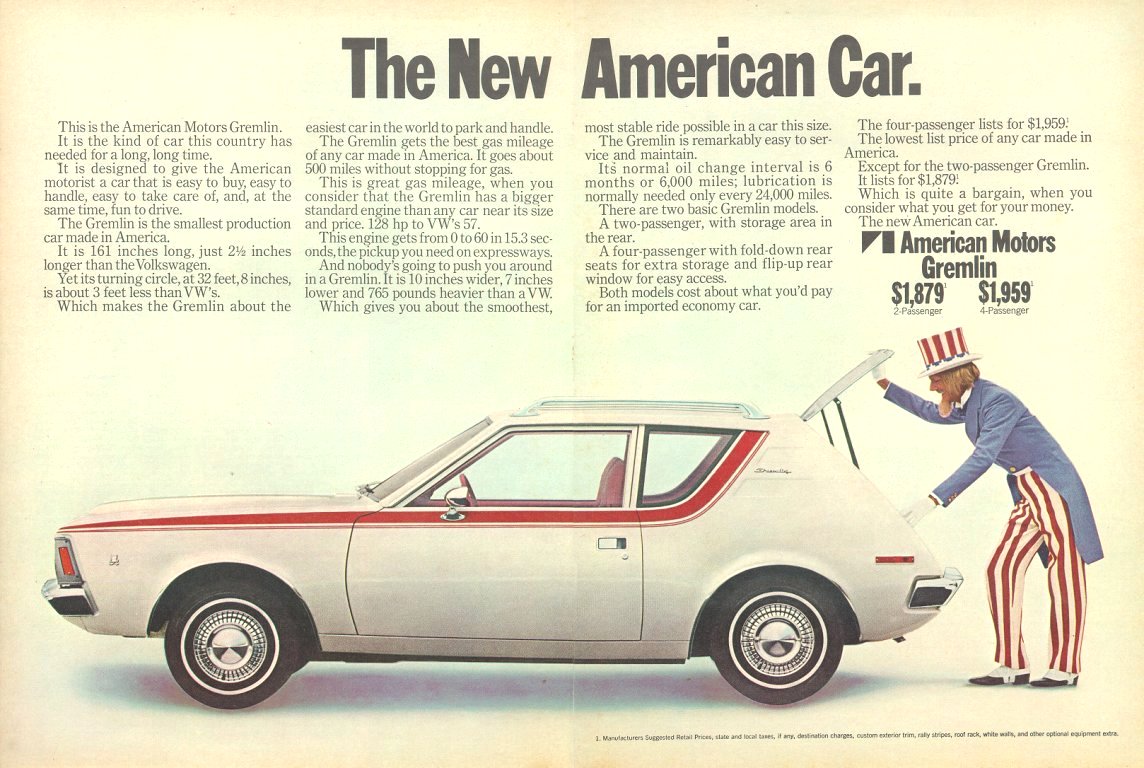
On April Fools Day of 1970, AMC - America's (distantly) fourth largest automaker - stole a march on giants GM and Ford by being the first American manufacturer to offer an import-fighting subcompact car. The truncated AMC Gremlin was basically an AMC Hornet with its tail bobbed and the rear wheels brought forward a foot. And its love-it-or-hate-it styling and tongue-in-cheek name got people's attention quickly. The Gremlin's range of big, smooth, powerful (for the day) inline-six cylinder engines was attractive to Americans who weren't convinced that the imports' inline-4s could provide the power, smoothness, and reliability they'd expected from the bigger American cars they were used to. Six months later, the competing '71 Chevy Vega and Ford Pinto (Chrysler took the easy way out and imported Dodge-badged Mitsubishis, and Plymouth-badged Hillmans instead of making their own American subcompacts), debuted with only 4-cylinder engines, which would prove to be a bit more economical than the Gremlin's big sixes, but far less reliable and responsive. And compared to the - by then ubiquitous - VW Beetle, the Gremlin had similar fuel mileage, with more than double the horsepower, and far more interior space. Despite all of its big-car advantages, it debuted as the lowest-priced American-made car. And sales were good.


In '72, AMC ratcheted up their quality and introduced the Buyer Protection Plan, the first bumper-to-bumper warranty offered on the American car market. It came standard on the Gremlin, too, which also picked up a V8 engine option to catch muscle car buyers turned away by soaring insurance rates. AMC even included denim seats as an option on the Gremlin, as a way to reach out to the youth culture of the day. In ads, they called it "the car that wears the pants". The fun shape, practical design, trusty, powerful engines, and lighthearted advertising worked, and sales were brisk through the first 5 years of the car's run. More than 171,000 were sold in 1974 alone.

But then AMC spent a ton of money on cars that were distinctively styled like the Gremlin, but not as well thought-out - the '74 Matador Coupe and '75 Pacer, specifically. And when those cars didn't make the money AMC needed to keep the rest of its product line up-to-date, the little car company soon found itself in big trouble.


By '78, Gremlin sales were poor having to compete with minimal changes with an onslaught of new Japanese small cars. Only 22,000 Gremlins were sold that year. And so AMC took a little out of their dwindling cash reserves and facelifted it, adding a fastback coupe version to accompany its existing chopped-tail bodystyle, and called them both the Spirit for '79. What resulted was a car that looked much more modern, was well-equipped, and sold better than it had in years. For a time. But it wasn't quite enough to move the needle for the company, so AMC decided to sell a 5% stake to French carmaker Renault that same year to generate some cash.

Wednesday, January 27, 2010

AP Spotlight: 1970-74 SAAB Sonett III

Car of the Week is back, and in honor of the recently inked deal between GM, Saab, and Dutch sports car maker Spyker Cars NV, Automotive Playbook's Car of the Week is a sports car from SAAB's past - the 1970-74 Sonett III.


As the name suggests, the Sonett III was the third iteration of SAAB sports car. The Sonett I, or 94, was sold from 1955-57 and equipped with a 748cc two-stroke inline-3 producing all of 58bhp in a car that weighed around 1200lbs, good for a 99mph top speed. The car got its name from the Swedish expression sa natt, meaning "so neat". But only six examples were built before SAAB canceled the project in early 1957.


The Sonett name lay dormant for another 9 years, until the Sonett II, or 97, was produced beginning in 1966. Intended as a racing vehicle, the little Sonett II competed well in contemporary Sports Car Club of America races, with its light weight and spunky two-stroke 841cc "Shrike" Inline-3 engine driving the front wheels. Criticisms by the motoring press - during the burgeoning muscle car era - had mostly to do with the car's lack of grunt, as well as its "homemade styling". After only two years, SAAB corrected the former problem by licensing Ford's German Taunus V4 engine. And, as befits legendary Swedish sensibility, changed the name from Sonett II to Sonett V4. But they made the styling problems worse because they had to redesign the hood with a rather unsightly bulge down the center to accommodate the much larger 1.5L mill.


Seeing that they'd made the already quaint-looking SAAB's styling worse, the company contacted Italian designer Sergio Coggiola, who helped pen a whole new body to ride atop the Sonett chassis. Debuting in 1970, SAAB called the car the Sonett III, and threw in an enlarged 1.7L V4 engine to give the car its highest-ever top speed of 103mph.

Sunday, December 13, 2009

Who Put the "Crisis" In "Chrysler"? (Part 1 of 2)


The Chrysler Corporation is an 84 year-old with Bipolar Disorder. There is no better way to describe the company.

Their history reads like a giant roller-coaster ride of manically high highs and depressively low lows. In the last 30 years alone, Chrysler has been at death's door 3 separate times (1979-81, 1990-92, 2007-present), and taken US Government bailout money twice (in 1980 and 2008/9).

They were on the ropes in the early 1960s because they downsized their cars when everyone wanted them bigger and more powerful; the early '50s because they'd restyled the entire line way too conservatively for the first "Age of American Excess"; the mid-'30s because they'd practically bet the farm on odd-looking aerodynamic "Airflow" cars that were too far ahead of their time for people's tastes; and were founded by Walter P. Chrysler in the midst of the collapse of Maxwell-Chalmers in the mid-1920s.

But their highs have been incredible. After being saddled for half a decade with stodgy designs, Chrysler debuted new "Forward Look" cars in 1955 and '57 that sent GM and Ford scrambling to compete. Chrysler's longer, lower, wider designs, advanced engineering, and pioneering features pushed Plymouth, Dodge, DeSoto, Chrysler, and Imperial sales through the long, sweeping roof and set trends the industry would follow for years.

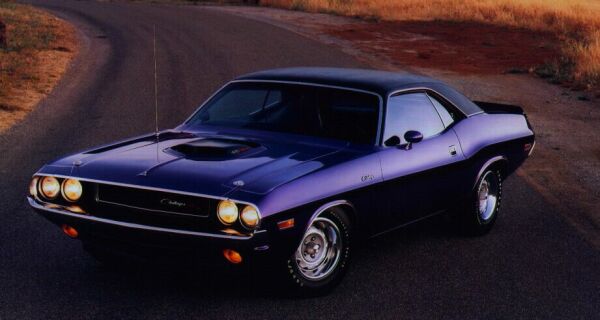
The late '60s and early '70s were kind to Chrysler, as well. Their big and midsize cars got slick "fuselage" styling. Their muscle cars were hot and there were plenty of them (Duster 340, Barracuda, GTX, Road Runner, Superbird, Challenger, Charger, Charger Daytona, Coronet Super Bee, and Sport Fury GT). Their all-new trucks and vans were winning people over. And their compact Darts and Valiants were selling out to the bare walls.

With Lee Iaccoca at the helm in the '80s, Chrysler climbed out of the grave by introducing the popular, economical K-Cars, the reintroding the convertible, and inventing the minivan. Chrysler came back quickly enough in the '80s to repay their government bailout loans ahead of schedule. They were doing so well, in fact, they went on to purchase American Motors, the fourth volume American vehicle manufacturer, in 1987, and picked up AMC's hugely profitable Jeep division for $1.1 billion in the process.

And as recently as 1998, the smallest of the Detroit Three was the most profitable among them. Chrysler had been totally turned around from its early '90s slump by offering swoopy "cab-forward" sedans (e.g., Dodge Intrepid, Chrysler Cirrus, Plymouth Neon), "rule-changing" Ram pickups, minivans for which they'd "thought of everything", and wild concept cars like the Viper and Prowler that were brought to production largely unchanged from their show car forebears.

So, what happened this time? Why is Chrysler once again swirling the drain, taking bailout money, and producing lousy, unimaginative products? Hadn't they learned their many lessons from the past?They probably had, actually.