Showing posts with label AP Spotlight. Show all posts

Monday, March 29, 2010

AP Spotlight: 1981-82 AMC Eagle Kammback


The car in the spotlight this time is a rare car, indeed: the 1981-82 AMC Eagle Kammback. If you're under 30, you've probably never seen one in person.

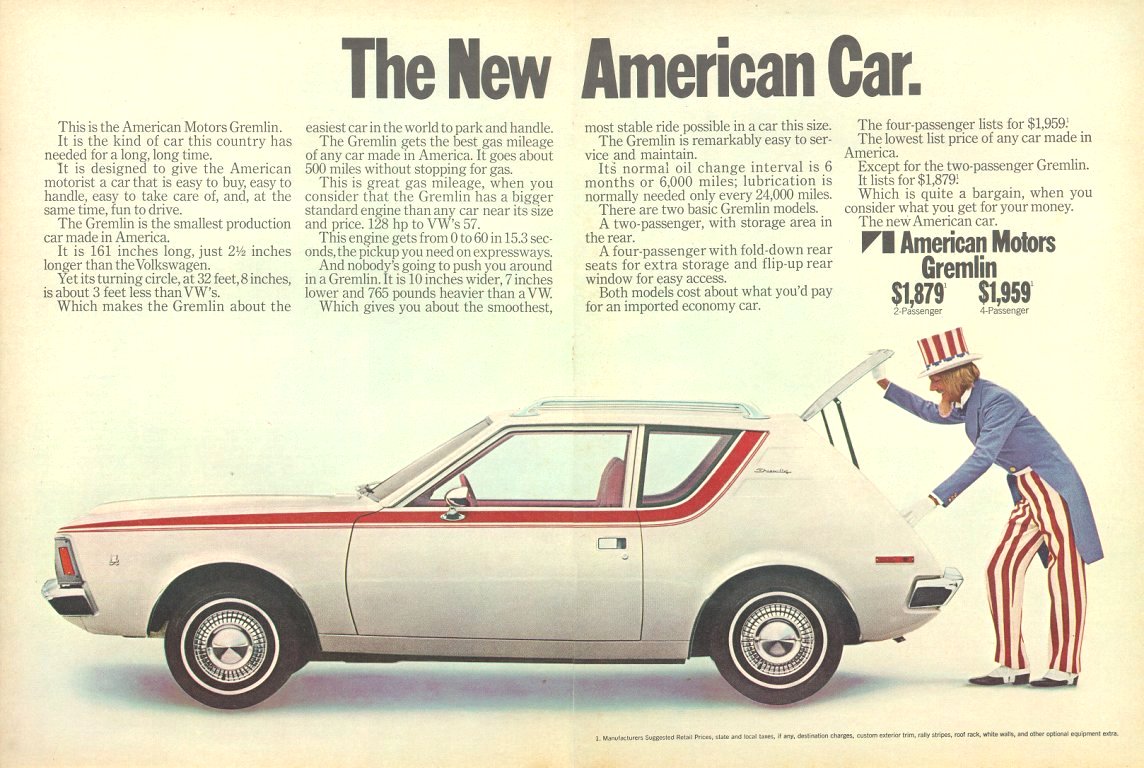
On April Fools Day of 1970, AMC - America's (distantly) fourth largest automaker - stole a march on giants GM and Ford by being the first American manufacturer to offer an import-fighting subcompact car. The truncated AMC Gremlin was basically an AMC Hornet with its tail bobbed and the rear wheels brought forward a foot. And its love-it-or-hate-it styling and tongue-in-cheek name got people's attention quickly. The Gremlin's range of big, smooth, powerful (for the day) inline-six cylinder engines was attractive to Americans who weren't convinced that the imports' inline-4s could provide the power, smoothness, and reliability they'd expected from the bigger American cars they were used to. Six months later, the competing '71 Chevy Vega and Ford Pinto (Chrysler took the easy way out and imported Dodge-badged Mitsubishis, and Plymouth-badged Hillmans instead of making their own American subcompacts), debuted with only 4-cylinder engines, which would prove to be a bit more economical than the Gremlin's big sixes, but far less reliable and responsive. And compared to the - by then ubiquitous - VW Beetle, the Gremlin had similar fuel mileage, with more than double the horsepower, and far more interior space. Despite all of its big-car advantages, it debuted as the lowest-priced American-made car. And sales were good.


In '72, AMC ratcheted up their quality and introduced the Buyer Protection Plan, the first bumper-to-bumper warranty offered on the American car market. It came standard on the Gremlin, too, which also picked up a V8 engine option to catch muscle car buyers turned away by soaring insurance rates. AMC even included denim seats as an option on the Gremlin, as a way to reach out to the youth culture of the day. In ads, they called it "the car that wears the pants". The fun shape, practical design, trusty, powerful engines, and lighthearted advertising worked, and sales were brisk through the first 5 years of the car's run. More than 171,000 were sold in 1974 alone.

But then AMC spent a ton of money on cars that were distinctively styled like the Gremlin, but not as well thought-out - the '74 Matador Coupe and '75 Pacer, specifically. And when those cars didn't make the money AMC needed to keep the rest of its product line up-to-date, the little car company soon found itself in big trouble.


By '78, Gremlin sales were poor having to compete with minimal changes with an onslaught of new Japanese small cars. Only 22,000 Gremlins were sold that year. And so AMC took a little out of their dwindling cash reserves and facelifted it, adding a fastback coupe version to accompany its existing chopped-tail bodystyle, and called them both the Spirit for '79. What resulted was a car that looked much more modern, was well-equipped, and sold better than it had in years. For a time. But it wasn't quite enough to move the needle for the company, so AMC decided to sell a 5% stake to French carmaker Renault that same year to generate some cash.

Saturday, March 13, 2010

AP Spotlight: 1993-95 Mazda RX-7


It may be hard to imagine now, as Toyota endures its current safety recall nightmare and Honda loses focus, but as little as 15 years ago, the Japanese auto manufacturers built not just solid, reliable cars, but exciting, soul-stirring sports cars. From 1985 to 2000, the list of Japanese sports cars offered in America - both legendary and forgotten - was massive:


Many of them had pop-up headlights, high-strung turbocharged engines, all-wheel-drive powertrains, and even 4-wheel steering setups. Back in the day, the odds were that if it was Japanese and had 2 doors, it was a technological and performance tour-de-force. They made the traditional American and European sports cars of the day look positively dowdy, pudgy, and agricultural by comparison.

By the year 2000, though, most of them were either gone or on their way out as their manufacturers stopped running the performance race, but instead raced to the middle to offer buyers bland sedans by the hundreds of thousands. Today, only 6 of the above sports car legends survive in any form. This week's Car of the Week celebrates the prettiest, yet among the shortest-lived (in America, anyway) of them all - the 1993-95 Mazda RX-7.


Of all the major Japanese auto manufacturers, Mazda has always gone their own way. Ever since their entrance into the American market in 1970, the company has positioned itself as a maker of vehicles that had a few things in common with each other: responsiveness, attainable performance, and driving enjoyment best described by their own marketing department as "zoom-zoom".

Saturday, February 6, 2010

AP Spotlight: 1962-70 Jaguar Mark X and 420G


In honor of the 75th Anniversary of the Jaguar name, this week's feature is the car that would inspire Jaguar design for nearly 50 years: the large, lush, and lustrous Jaguar Mark X and 420G, made from 1962-70.


The Mark X was a milestone vehicle for Jaguar, in part because it set the styling mold in which most Jaguars would be cast for 48 years hence. However, its importance in the Jaguar lineage was underscored by the fact that the independent rear suspension that debuted under it, at the same time as did on the storied E-Type, remained in production for 35 years, until the last 1996 Jaguar XJS rolled off the line. What's more, the 4.2L version of Jaguar's world-beating XK family of inline sixes debuted in the Mark X in 1964, and would go on to power the high-luxury Daimler DS420 limousine until 1992, an amazing 28 years later.

Wednesday, January 27, 2010

AP Spotlight: 1970-74 SAAB Sonett III

Car of the Week is back, and in honor of the recently inked deal between GM, Saab, and Dutch sports car maker Spyker Cars NV, Automotive Playbook's Car of the Week is a sports car from SAAB's past - the 1970-74 Sonett III.


As the name suggests, the Sonett III was the third iteration of SAAB sports car. The Sonett I, or 94, was sold from 1955-57 and equipped with a 748cc two-stroke inline-3 producing all of 58bhp in a car that weighed around 1200lbs, good for a 99mph top speed. The car got its name from the Swedish expression sa natt, meaning "so neat". But only six examples were built before SAAB canceled the project in early 1957.


The Sonett name lay dormant for another 9 years, until the Sonett II, or 97, was produced beginning in 1966. Intended as a racing vehicle, the little Sonett II competed well in contemporary Sports Car Club of America races, with its light weight and spunky two-stroke 841cc "Shrike" Inline-3 engine driving the front wheels. Criticisms by the motoring press - during the burgeoning muscle car era - had mostly to do with the car's lack of grunt, as well as its "homemade styling". After only two years, SAAB corrected the former problem by licensing Ford's German Taunus V4 engine. And, as befits legendary Swedish sensibility, changed the name from Sonett II to Sonett V4. But they made the styling problems worse because they had to redesign the hood with a rather unsightly bulge down the center to accommodate the much larger 1.5L mill.


Seeing that they'd made the already quaint-looking SAAB's styling worse, the company contacted Italian designer Sergio Coggiola, who helped pen a whole new body to ride atop the Sonett chassis. Debuting in 1970, SAAB called the car the Sonett III, and threw in an enlarged 1.7L V4 engine to give the car its highest-ever top speed of 103mph.

Wednesday, January 6, 2010

AP Spotlight: 1965 Buick Riviera


A friend of mine just this evening asked me the following question:

If you could have any non-new car that costs less than $100,000.00, what would it be?

The answer to this question changes weekly. Tonight, as I was searching for photos of the vehicle in question, the thought occurred that my constantly changing automotive infatuations might make for a half-decent midweek feature for Automotive Playbook. So what the heck. I'll try it out.


This week, it's the 1965 Buick Riviera. This is an extremely pretty car, in my opinion. But I'm not alone in it. Sergio Pininfarina, renowned designer of many classic Ferraris, said that this vintage of Riviera "[is] one of the most beautiful American cars ever built; it has marked a very impressive return to simplicity of American car design."


The car debuted with this body for 1963. But by 1965, Buick made some changes. They moved the horizontal quad headlights from the grille to the front fenders. But rather than leave them exposed, Buick stacked them and hid them behind retractable grilles. This emphasized the width of the front, giving it a smoother, meaner look and gobs of road presence.


The dummy twin air scoops that were mounted on the rear fenders just aft of the front door aperature from '63-64 were dropped in favor of a cleaner, smoother look. Chrome rocker panel moldings stretched between the wheel wells, emphasizing the car's visual length, while reducing its visual height. To further emphasize the long, low look of the Riviera, Buick mounted its tail lamps lower in '65, integrating them into the rear bumper.


The '65s were also special because they were the first of Buick's personal luxury coupes to offer the famous Gran Sport option package. Buyers who selected it could get a heavy-duty suspension system, power steering and disc brakes, and a limited slip differential for better wet traction and faster starts off the line.

The centerpiece of the Gran Sport package, though, was the new 425ci (7.0L) V8 engine that breathed through dual 4-barrel carburetors, making 360 gross horsepower and 465 lb-ft of torque. Called the "Super Wildcat 465", the engine gave the 1965 Riviera GS athletic performance to complement its pretty-boy looks.

And though it may have only had 4 seats accessed through two long, heavy doors, the Riviera wasn't impractical inside. Not in the least.


Both front and rear seat passengers were offered more than enough space to stretch out and relax, with enormously comfortable seats and a light, airy, glassy cabin that freed passengers from the claustrophobic feelings that were all too common in contemporary sporty cars. The two rows of plush bucket seats were divided by their own consoles, giving each person, front or rear, the sense that they were being enveloped and cosseted by a truly luxurious car.

The Riv also earned practicality points at the rear, with a trunk that was easily commodious enough for four people's weekend luggage.


All in all, the 1965 Buick Riviera GS offered mighty performance, a satisfying dose of practicality, and good enough looks to cause excessive salivation. It was the car to have for the time. And today, 45 years later, it's not one iota less impressive or desirable. Today, a ridiculously well-restored example will fetch about $30-$40,000. One in good, daily driver condition should run about $10-$15k.

The 1965 Buick Riviera: GS or not, it's an achingly beautiful, competent, historically significant piece of rolling automotive sculpture. It's part of the reason that this writer has such a soft spot in his heart for Buick today.


Buick needs to start making cars like this again. And soon.